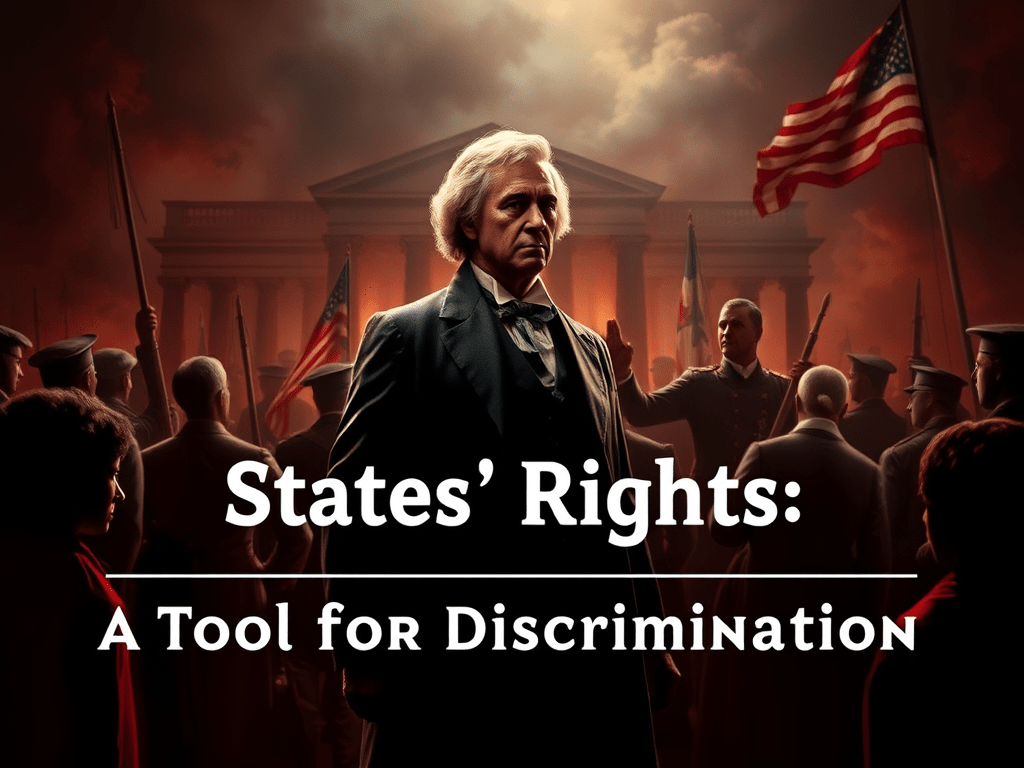
States’ Rights.
In the last few years we have seen a resurgence of the mantra “States’ Rights” or “States are entitled to rule themselves and the Federal Government should stay out of it” from the GOP. Specifically, they have used this argument to justify overturning Roe v. Wade and to dismantle the Department of Education. On its surface, especially if we want to take an extremely fundamentalist reading of the Constitution that the 10th amendment unequivocally reserves the right for States to govern themselves in all things not enumerated to the federal government, or denied to the States, by the Constitution, this is not an unfounded position to take. This would include things like education and medical procedures.
The problem is that the argument of “States’ Rights” has never been about anything other than the States ability to discriminate. It has always been a clarion call for white, male supremacy.
In 1824 Andrew Jackson lost the presidential election to John Quincy Adams in a contested election that was decided in a contingent election by the House of Representatives in 1825. As no candidate had won an electing majority of the electoral college votes the House decided the election as is laid out in the US Constitution. Adams went on to name Henry Clay, another candidate, as Secretary of State in what Jackson supporters began to call the “Corrupt Bargain”. They alleged that Clay had “sold his support” to Adams in exchange for the position and this deal defeated Jackson in the house even though he had garnered the most popular votes and a larger share of the electoral votes during the general election in 1824.
Southern slave owners latched onto the narrative of the “Corrupt Bargain” and began to characterize the Federal Government as a distant, out of touch body that was trying to push their ideals onto them with no regard for their “culture” or needs. They said that States’ Rights mattered more than anything else in this nation. They threw their support behind the populist candidate Andrew Jackson and elected him in 1828 to the Presidency. This began the movement in the South proclaiming that the states, and the states alone, should determine what was and wasn’t legal in their states, specifically slavery. They were still extremely upset at the Missouri Compromise of 1820 that ended the proliferation of slavery in new states admitted to the Union. With the way the Framers had laid out representation in Congress, Southern democrat slave owners quickly saw that this would end their ability to influence domestic policy as they would lose their thin majority in the legislative bodies as more non-slave states were admitted. Thus began the campaign that States, and States alone, had the ability to determine their governance. They desperately needed to maintain their States’ Right to slavery in order to preserve their power over their hierarchical society.
The irony here is that Andrew Jackson sparked the Nullification Crisis over tariffs when he authorized the use of the military to enforce federal law in South Carolina.
In 1857, the Supreme Court handed down the Dred Scott v. Sanford decision, which is regarded as the worst ruling in the Court’s history. For now at least. With this ruling they codified that the US Constitution did not extend citizenship to Black Americans and that Congress had no authority to legislate against Slavery. This only emboldened the Southern slave owners to continue their rhetoric of the sanctity of States’ Rights and set the table for the secession crisis that led to the Civil War. It’s worth noting that Chief Justice Taney, who handed down the decision, was from a wealthy slave owning family in Maryland. He was appointed to the Supreme Court by Andrew Jackson.
If you have never read the Court opinions from this case, and you’re a sicko for American history, I highly encourage that you do. It is incredibly racist and filled with tenuous logic to connect the decision that Dred Scott couldn’t be a citizen because he was the property of a white man to the argument that Congress couldn’t legislate slavery because it impeded on property rights which are determined by the States themselves. Taney used this judgment to overturn the Missouri compromise of 1820, which was not relevant to the case they were hearing. Instead using his decision that another human was property to leap to striking down a ruling that impeded wealthy slave owners like himself and his family. He unilaterally galvanized States’ Rights to discriminate and enslave other humans.
To be explicitly clear, the Civil War was about secession. And secession was about slavery. Any other reason offered is a lie. A product of Southern propaganda after the war during Reconstruction.
This is relevant today, some 200 years later, because “States’ Rights” is still about wealthy white men being able to discriminate against marginalized people. As it always has been.
The Dobbs decision, which effectively overturned the Roe v. Wade decision that federally protected the right to abortion, was ostensibly made to return the power to the States to make that decision for themselves. On its face, this isn’t a terrible decision if we take a fundamental position on the enumeration of rights. However, many States took this opportunity to completely deny reproductive rights, with some taking notes from laws codified in the 1850’s. There should be no surprise that there is a geographical overlap of this modern denial of rights and a history of slavery. The guise of “States’ Rights” was once again used by white men in power to deny the rights of who they view as second class citizens.
In March of 2025, President Donald Trump signed an Executive Order directing the shut down of the Department of Education. Again we see the championing of “States’ Rights” being used to justify this decision. To be fair, federal oversight of public education is not enumerated in the Constitution and thus we can take a fundamentalist argument for this being the correct decision. However, this decision does not exist in a vacuum where it can be isolated in such a way. In context, this decision comes as the last major domino of years of GOP efforts to undermine public education and drive students towards private schools. Specifically wealthy, and predominantly white, students. This is not to say that the DoE is without fault, or that they do a great and glorious job at providing for our nation’s students. Their most important function is providing oversight and regulating States to provide access to education for disabled and marginalized students, something private schools have no mandate to do unless they receive federal funding. By removing the DoE, they are removing this funding, and thus removing the obligation of Private schools to provide access to education for anyone who doesn’t fit their preferred image. Once again, the argument of “States’ Rights” is being used to discriminate against demographics that are not wealthy or white.
“States’ Rights” is, and always has been, about the rights of wealthy white men to deny the rights of people they see as beneath them. It is a constitutional smoke screen to disguise hierarchical institutions that benefit only a select few. A select few that know if the most American tenet of “all men are created equal” were to actually rule the land they would lose their protected access to power and wealth derived from the labor of the average American.
— The People. Of, By, and For
 The People. Of, By, and For
Leave a comment